Showing posts with label genre: historical. Show all posts

Thursday, November 1, 2012

Review: A Thunderous Whisper by Christina Diaz Gonzalez

Title: A Thunderous Whisper
Author: Christina Diaz Gonzalez
Genre: Historical Fiction
Release Date: October 9, 2012
Publisher: Knopf
Format: eARC
Pages: 304
Source: Publisher via NetGalley
Links: Goodreads | Amazon | Bookdepository
Read from October 7 to 9, 2012
My rating: 3 stars: I like it (2.5)
Summary: Ani believes she is just an insignificant whisper of a 12-year-old girl in a loud world. This is what her mother tells her anyway. Her father made her feel important, but he's been off fighting in Spain's Civil War, and his voice in her head is fading. Then she meets Mathias. His family has just moved to Guernica and he's as far from a whisper as a 14-year-old boy can be. Ani thinks Mathias is more like lightning. A boy of action. Mathias's father is part of a spy network and soon Ani finds herself helping him deliver messages to other members of the underground. She's actually making a difference in the world. And then her world explodes. The sleepy little market town of Guernica is destroyed by Nazi bombers. In one afternoon Ani loses her city, her home, her mother. But in helping the other survivors, Ani gains a sense of her own strength. And she and Mathias make plans to fight back in their own unique way.

No matter how loud the world gets, sometimes a single voice can be heard. 

I was first interested in this book because it's about World War II, and because someone said it is like The Book Thief, which is my number 3 most favorite book of all time. And when someone makes a comparison like this, I couldn't help but feel the need to check this book out, as it could be the next best thing that would happen to me for all I knew.

But it wasn't. It's not bad, but it's nowhere near as life-changing or sublime as Markus Zusak's masterpiece. It does have some lovely quotes that I highlighted, but other than that I didn't like anything particular about it. I wasn't into the story—I found the idea that small children can make a difference a bit too optimistic and far-far-fetched.  I was turned off by this notion, to be honest. Maybe this is because I didn't feel like the story portrays it convincingly enough, or well enough, or just enough. And in the end, I didn't believe they make any significant differences at all, and I mean at all, so that renders the title, A Thunderous Whisper, and what it stands for kind of invalid to me. And unlike The Book Thief's, the characters in this book aren't outstanding enough to secure a place in my heart. Most of the time I was just irritated by Ani and her mother.

This was an okay read to me. It's not that boring, not that bad, but also not that good. I expected it to be more interesting, but it sadly didn't measure up.

 ------------------------
This review is also posted on Goodreads.
I received a digital copy from NetGalley and the publisher for review.

Friday, August 10, 2012

Review: Kissing Shakespeare by Pamela Mingle

Title: Kissing Shakespeare 
Author: Pamela Mingle 
Genre: Young Adult, Historical Fiction
Release Date: August 14, 2012
Publisher: Delacorte Books for Young Readers
Pages: 352
Format: eBook
Source: Publisher via NetGalley
Links: Goodreads | Amazon | Bookdepository
Read from August 4 - 9, 2012
My Rating: 3 stars: I like it
Summary: Miranda has Shakespeare in her blood: she hopes one day to become a Shakespearean actor like her famous parents. At least, she does until her disastrous performance in her school's staging of The Taming of the Shrew. Humiliated, Miranda skips the opening-night party. All she wants to do is hide. Fellow cast member, Stephen Langford, has other plans for Miranda. When he steps out of the backstage shadows and asks if she'd like to meet Shakespeare, Miranda thinks he's a total nutcase. But before she can object, Stephen whisks her back to 16th century England—the world Stephen's really from. He wants Miranda to use her acting talents and modern-day charms on the young Will Shakespeare. Without her help, Stephen claims, the world will lost its greatest playwright. Miranda isn't convinced she's the girl for the job. Why would Shakespeare care about her? And just who is this infuriating time traveler, Stephen Langford? Reluctantly, she agrees to help, knowing that it's her only chance of getting back to the present and her "real" life. What Miranda doesn't bargain for is finding true love . . . with no acting required.


"How would you like to meet William Shakespeare?" A laugh burst from my mouth. "You're crazy." 

When time-traveler Stephen Langford chooses Miranda as the one to take back to the 16th century to save young William Shakespeare from becoming a Jesuit, she doesn't have a choice but to go along with him. Once there, Miranda has to learn to adapt to the way of life of the people in that century, and she also has to pretend to be Stephen's sister, Olivia, while the real one is sick at home. Her mission here is to seduce her idol William Shakespeare, to make him realize that he's a guy suited for worldly things, and that the religious path is not for him. If she succeeds, she can save Shakespeare from being hunted down for being a Jesuit, and she can also save all of Shakespeare's works in the future from vanishing, and save the future forever.

I'll try to keep this review short and simple for there isn't much to say. I didn't expect anything when I started this book, so I wasn't disappointed. It's pure fun and a good break from all the crazy stuff going in my life right now. It's one of those enjoyable books you don't expect to get anything out of, which you don't anyway even if you try.

Some of the plots aren't very well-executed. I'd love to know more about Stephen's time traveling, which the author gives me no chance to. There's a scene where Miranda dresses herself as a boy and everyone believes her. Eh? And then there's this huge plothole that bothered me. The author has Stephen tell Miranda that the time she belongs in won't move on without her -- when she returns, it will be as if no time has passed. As a believer of logic, I wasn't satisfied with this explanation. But I knew this was all I was going to get.

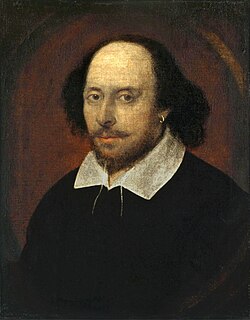
The characters are flat and mediocre. I regret to say that Shakespeare doesn't play the main role in this story. I kept picturing him like this and cringed every time because it wasn't fitting. This book talks about the younger Shakespeare, of course. And when I pictured him with Miranda, he looked like a pedobear to me. This problem is caused by the fact that the author doesn't bother telling us about any character's appearances. I don't know if this was intentionally done or she just forgot. The 16th century is hard enough to picture, and I'd love to know what the characters look like.

I like the ending. Love doesn't always have to work out, you see. I think this ending leaves a lingering haunting feeling, which is much better than if it'd gone for the happily-ever-after. I'm tired of authors trying to make impossible love work. I find the ending especially refreshing.
"As much as it hurts to admit it, I knew he was right. I would love him with all my heart, but in the end, it wouldn't be enough. I'd long for everything I couldn't  have, and that would kill the love between us. Not right away, but someday." 
This is the best part of the book in my opinion.

Looked at in parts, the elements of this book don't seem to work, but together they do. I don't know why and I don't know how to explain. It just works, unless you expect it to be spectacular. If you don't think much about it, you might find it enjoyable and light and fun. But that's really just about it.


------------------------

This review is also posted on Goodreads.
I received a digital copy from NetGalley and the publisher for review.

Friday, May 18, 2012

Review: Music from Beyond the Moon by Augusta Trobaugh

Title: Music from Beyond the Moon 
Author: Augusta Trobaugh 
Genre: Historical Fiction
Release date: April 30, 2012
Publisher: Bell Bridge Books
Format: eBook
Pages: 266
Source: Publisher via NetGalley
Links: Goodreads | Amazon | Bookdepository
Read from April 28 - May 17, 2012
My rating: 2 stars: Nothing special
Summary: She became his soul mate and first love, but can he and she escape a destiny that was decided before they were born? In 1920’s Florida, an abandoned baby boy grows up under a cloud of mystery, adopted by two strong southern women who try to protect him from his family’s secrets and heartaches. But even their best intentions and deepest devotion can’t hide the truth forever or soften the fate that faces both him and the girl he loves. Augusta Trobaugh’s unforgettable novel speaks of loyalty, loss, the difficult choices we make in the name of family, and of courageous hope, each inspired by the fragile and painfully longing music of life, a song that seems to come from beyond the moon.


"That's what love is like—it's mysterious and far away, and we can never even really touch it—never hold it tight at the same time, never let it go. But we can hear it sometimes, honey. Like music. Music from beyond the moon."


The first thing I have to say about this book is that I'm glad I finally got it over with. Had it been a wonderful read? No, not really. Was it more like a sleeping pill? Yes, yes, yes, definitely! After 20 days, an end was put to this misery of mine. Who'd have thought a 266-page book could take me this long to finish? This book is incredibly boring. There, I came right out and said it. Am I being harsh? Maybe. But if I were a reader looking for the next book to read, and thought this book might be it, that's what I'd want to know. There are a lot more better ways to spend your time than with the wrong book, trust me.


Music from Beyond the Moon started off pretty amazingly for a book that could literally bore me to tears. It's 1924 when a baby boy is abandoned by his mother in the backyard (I think) of a house owned by two southern women in a place called Love-Oak in Florida. The women, Fiona and Glory, take him into their home and give him all the love in their world. They give him a name (Victor), love him and raise him like he was their own. But the plot isn't what I'm talking about here. Here is the one thing I liked about this book: the writing. I could see vivid details of what was going on. I could feel the emotions coming out of the characters. I loved that. The author's words are very well chosen and they form these amazing sentences. Oh, her writing is gorgeous! I'm a sucker for good writing, alright.

Here's my favorite:
"Her thoughts are like wild birds flying blindly around a cage they didn't know was there."

I loved the way her words are strung together. It's kind of sad that that's where the compliment has to end. However good the author's way with words may be, I can't like her book if the story isn't well written, and that's definitely the case. I lost interest as soon as 2% of the book was over. That's just about how good the book is to me. That's a little before the part where the author started making the book so off-topic and lose its focus on the story that it was hard for me to try to understand why she did this. That's where enjoyment ended and "tolerance" started.

There are quite a number of  problems I had with this book. The author seemed to have written everything about every one of the character, which is quite over the top. Do I need to know how the lives of everyone were before the book starts? Of course not. Most of those things are totally unnecessary. So many stories about the past of these characters are put in the book that it made me wonder what this book is really about, and whom it is supposed to focus on. I understand that the past needs to be told in order to shape the future, but it really wouldn't be that difficult to cut out the mumbo jumbo and unnecessary sub-plots, would it? That would have made my reading much easier and more comfortable. This book has a problem staying focused on the main plot, and that's very annoying. It leads you off-topic for what seems like 20 pages and that makes it hard to get back on track, and you don't remember anymore what was happening before that. When a book is written in this manner, it usually gets a bye-bye from me.

The message of this book to me is pretty clear. Since Music from Beyond the Moon is a book about love and the tragedy it brings, its makes you see how love can break you and how terrible something as wonderful as love can be. Heartbreaking stories of each character are told one after another: A woman who thought she knew love but didn't; a good girl gone bad loving the wrong guy; a mother who had to go; love between two young people that just can't be; etc. Sometimes I could feel their pain, but most of the time I was annoyed instead. I would've really liked this book if it hadn't been for the way it was written.

So here's the bottom line: I wouldn't recommend this book to anyone.


------------------------

This review is also posted on Goodreads.
I received a digital copy from NetGalley and the publisher for review.

Wednesday, February 8, 2012

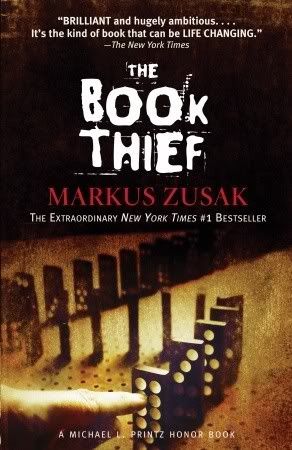
Review: The Book Thief by Markus Zusak

Title: The Book Thief
Author: Markus Zusak
Genre: Historical
Release Date: March 14, 2006
Publisher: Alfred A. Knopf Books
Pages: 550
Format: Paperback 
Literary awards: National Jewish Book Award, Book Sense Book of the Year Award for Children's Literature (2007), Prijs van de Kinder- en Jeugdjury Vlaanderen (2009), Printz Honor (2007), Exclusive Books Boeke Prize (2007), Exclusive Books Boeke Prize (2007), Zilveren Zoen (2008), Teen Read Award Nominee for Best All-Time-Fave (2010), Deutscher Jugendliteraturpreis (2009), ALA's Top Ten Best Books for Young Adults (2007), Abraham Lincoln Award Nominee (2010)
Read from Janaury 21 - February 7, 2012
My rating: 5 stars: I love it! It's amazing! + Favorite

Summary: It is 1939. Nazi Germany. The country is holding its breath. Death has never been busier, and will be busier still. By her brother's graveside, Liesel's life is changed when she picks up a single object, partially hidden in the snow. It is The Gravedigger's Handbook, left behind there by accident, and it is her first act of book thievery. So begins a love affair with books and words, as Liesel, with the help of her accordian-playing foster father, learns to read. Soon she is stealing books from Nazi book-burnings, the mayor's wife's library, wherever there are books to be found. But these are dangerous times. When Liesel's foster family hides a Jewish fist-fighter in their basement, Liesel's world is both opened up, and closed down.

One word: wow. This book is beyond amazing. It's one of those books that leave you speechless right after finishing, and will continue to stay with you even as time flies by. All I could say at that moment was I'm finished. Wow. *wipes tears* Wow. Just wow. *blows nose* For real. It touched my heart and left an imprint on my soul. A new favorite for me. 

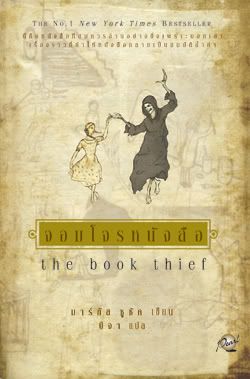
The Book Thief in Thai translation
I was reading this book two weeks before my midterm exams. So after two days of reading it, I had to put it on hold to study. I was able to continue reading after the exams were over. So you could say that I'd been reading this book for 6 days, not 17.

I've known The Book Thief since its publication in 2006. I feel stupid for not having been able read it sooner. I remember when I visited the national book fair 6 years ago, The Book Thief had just been published and was later translated into Thai and on sale for the first time there. I bought a copy. It came with its own nice paper bag that looked just like the cover, with gold print and all. I read the first chapter and then that was it. I wasn't much of a reader back then, nor was I any good at English. I'd promised myself that one day I would read the English original and understand it, and that happened just now, six years after the promise. I'm so glad I got to finish it and appreciate its beauty in its original text. I'm going to pick up the Thai translation one day and read to see if the translation lives up to the original at all.

“Like most misery, it started with apparent happiness.” The Book Thief tells a very complicated yet simple story. I don't quite know how to tell you this. This amazingly well-written book is narrated by Death himself during the World War II. And a beautiful narration it is, too. The book revolves around a young German girl named Liesel Meminger, whom Death calls The Book Thief. Liesel stole her first book, The Grave Digger's Handbook, when her brother was being buried in the snow, while they were traveling to Munich to live with their foster parents. She couldn't even read back then, but she stole it because she knew it would remind her of her brother and the train ride with their mother. Her foster parents are Hans and Rosa Huberman. Hans is a very fatherly person. He loves Liesel. He teaches her to read, plays her the accordion, and reads with her when she wakes up in the middle of the night screaming, after dreaming of the train and her brother again and again. Rosa, on the other hand, is a rude woman. She swears all the time. She also loves Liesel, but she doesn't show it. Liesel is getting used to the life on Himmel Street, and she makes some friends. Her best friend is Rudy Steiner, the boy next door, whose favorite thing to say to her is, "How about a kiss, Saumensch?", which gets rejected every time. Liesel is getting used to the life on Himmel Street until one day a Jew shows up before their house. Max Vandenburg, son of a friend of Hans' who once saved his life in the war, is kept hidden by the Hubermans in their basement. The Hubermans love him and care for him, still they can't shake the fear that the Nazi might find out there's a Jew in their basement. 


There's not a thing I don't like about the story, but right now let's talk about the narration. It's very unique and interesting (at least to me), because I have never read a book entirely narrated by intangibles before (Just in Case by Meg Rosoff is narrated partly by Fate and partly by third person point of view). Moreover, Death in this story isn't just death. Death has a cynical personality, and is haunted by humans. He's weary of his work, and he tries to understand humans. I've never looked at death that way before, but more like something sinister that loves taking away someone we love, so this really opened up my eyes. As someone who dreads and hates death, I think it's nice to see things through Death's eyes. It kind of made me think that maybe Death doesn't want to take anything away from us, but he has to. Just like the sun can't help but rise and shine every day. However, I might add that it didn't exactly make me feel any less negatively about death. It's just very interesting. So very interesting. I also loved that Death is impatient. He doesn't like mysteries: he will tell you the ending before you get there. The interesting thing is that it doesn't spoil the story at all. If anything, it enriches it, and keeps you on the edge of your seat. You know what, but not how, and you're dying to know the how. I guess it's not about the destination, it's all about the ride.

One of the rare things happened to me with The Book Thief: I loved the characters. Why is this a big deal? It is a big deal because I don't tend to have a lasting strong feeling about characters in standalone books (the only exception being Extremely Loud and Incredibly Close), and they don't stay with me. But not with this book. I loved the book lust in Liesel Meminger, just as much as I loved how she struggled to get over the death of her brother. I loved Rudy Steiner's ever-present starvation, his how-about-a-kiss-saumensch, his Jesse Owens event, his blond hair, his dusty bomb-hit lips. The only thing worse than a boy who hates you: a boy that loves you. Just thinking about him makes my eyes water. That boy is so wonderful. I also loved Hans Huberman, his accordion, his teaching Liesel to read, his staying up with her to get her through the night. He's a heavenly person. His calmness, kindness, his love. Rosa Huberman, however rude and tactless and wardrobe-like looking, is also lovable. She takes a Jew into her house without asking a single question or a having a single doubt. She reminds me of my mother, who doesn't talk very nicely, but whose love can be so great it can probably move a mountain. I loved the Jewish fist-fighter Max Vandenburg who always feels guilty about "having to put you all through this." I loved this guy because he dreams of fighting with Hitler, because he has written two books for Liesel, because he never asks for anything, because he makes me cry the most, because he is taken away, because he comes back, because.. because... just because.

You know, when you love a book this much, it's hard to find anything to say at all. You know what you say is not going to do the book justice. 

These characters, these people, this story. They'll stay in my heart for a long, long time. 

I don't know how he did it. Markus Zusak, I mean. 

Speaking of whom. His writing is extraodinary. Delightful. Magical. Reading his beautifully-strung-together words is pure joy. The words blew me away. I don't know how to explain it. They made me laugh, and they also moved me to tears. Heart-wrenching stuff. The power of words, indeed. Amazing what it can do to you, don't you think? 

I have a little advice for those of you reading this review who hasn't yet read this masterpiece of a book: DROP EVERYTHING NOW. READ THIS BOOK. 

Here goes my heart ♥.


------------------------

This review is also posted on Goodreads.

Wednesday, November 16, 2011

Review: Perfume by Patrick Süskind

Title: Perfume
Author: Patrick Süskind
Genre: Historical Fiction, Horror, Classics
First published: 1985
This edition: 2001
Publisher: Knopf Publishing Group
Format: Paperback
Pages: 272
Links: Goodreads | Amazon | Bookdepository
Read from November 9 to 15, 2011
My rating: 3 stars: I like it
Summary: In the slums of eighteenth-century France, the infant Jean-Baptiste Grenouille is born with one sublime gift - an absolute sense of smell. As a boy, he lives to decipher the odors of Paris, and apprentices himself to a prominent perfumer who teaches him the ancient art of mixing precious oils and herbs. But Grenouille's genius is such that he is not satisfied to stop there, and he becomes obsessed with capturing the smells of objects such as brass doorknobs and frest-cut wood. Then one day he catches a hint of a scent that will drive him on an ever-more-terrifying quest to create the "ultimate perfume" - the scent of a beautiful young virgin.


Everyone seems to like or love this book, but even to my surprise, I feel kind of underwhelmed. The story is without a doubt extraordinary and unusual, based on the idea that the sense of smell is superior to all others, as your other sensory perceptions can be turned off (shutting eyes, covering ears, etc.) except for smelling, so long as you want to live. However interesting it sounds, I often found myself not engaged with what was going on as I read at all. At some points I would look up from the book and feel so blank--I couldn't recall where the story had taken me and how it was going--that I had to flip back, sometimes a few pages, sometimes a lot of pages, to start again. I wasn't as absorbed in it as I had wanted to be. I came to conclude that it was because of the writing.

I had mixed feelings about the writing and the narrative. Sometimes, like I said, it seemed to push me away from grasping what it was telling me. I had to reread sentences or paragraphs a lot of times that it wore me out. However, there were times when it flowed so smoothly and rapidly that I actually enjoyed it. And I also noticed that what seemed like the first 73.07692% of the book was what I felt uneasy with, while the rest after it was somewhat livelier and more exciting. Or maybe all this is just me. Maybe it's just my reading deficiency. In addition, I felt like the narration could have been better and more detailed. When the killing spree part comes, it looks as if the author didn't care about it that much to give more details. I didn't like that. It was like writing one sentence to let the readers know that between this line and the line above, 23 murders had been committed and done. Like that. No more details. Also, kudos to the author's description of smell/scent/odor. I think it's great.

I have only a couple of thing to say about the storyline. Firstly, I think the author focused too much on the first stages of Grenouille's life. A lot of times I wondered why he has killed only one girl when it was almost 200 pages on already. I expected The Story of A Murderer to focus more on acts of murders, rather than what the murderer did in a perfume shop or in a cave. And I don't really like how Grenouille killed one girl in Paris once, paused--lived in a cave for SEVEN years, then started a killing spree, after all those years, which was described within JUST a few pages I think that it's unforgivably unbalanced. I felt the story goes all too slowly, and when the climax of the book comes, it's almost the end of the book itself, and that passes by all to quickly. Secondly, why did some people who gave him shelter have to die after Grenouille left them? What's with that? First, his cruel employee whose name I don't remember. Then Baldini the perfumer. Why? I mean, they didn't have any more significance in the story, why not just leave them alone? Why further going into details their deaths? Perhaps to portray that without him their lives couldn't go on? Hmm... This is quite unnecessary, why not focus on something that would enrich the story instead?

The main character, Jean-Baptiste Grenouille, with one crippled foot and tough personality, is an odorless person. I like how the obsession with scent has its motive from his own shortcoming. He wants to create an odor for himself. When reading about his unfortunate birth and tough childhood, I felt sympathy for him. Even when he's grown up and sinister, I still felt it. I think the author meant for it to be like that, to make the character seem real, to make readers sympathize with him, but dislike him all at the same time. Or at least that's how it was for me. His high ambitions and genius make him a murderer, yet he didn't seem to care much about that. He definitely took obsession to the next level.

This book is definitely fine literature, no doubt about that. But I have to say it didn't quite do it for me. It didn't blow me away, no matter how much I wanted it to. Perfume could, dare I say it, have been better. There.


------------------------

This review is also posted on Goodreads.
Related Posts Plugin for WordPress, Blogger...