Showing posts with label *favorite. Show all posts

Saturday, June 8, 2013

Review: The History of Love by Nicole Krauss

 photo 9historyoflove_zps7cf4a731.jpg
Title: The History of Love
Author: Nicole Krauss 
Genre: Contemporary
Release Date: January, 2005
Publisher: W.W Norton & Company
Format: Paperback
Pages: 260
Links: Goodreads | Amazon | Bookdepository
Read from May 17 to June 8, 2013
My rating: 5 stars: I love it! It's amazing! + Favorite
Summary: Fourteen-year-old Alma Singer is trying to find a cure for her mother’s loneliness. Believing that she might discover it in an old book her mother is lovingly translating, she sets out in search of its author. Across New York an old man named Leo Gursky is trying to survive a little bit longer. He spends his days dreaming of the lost love who, sixty years ago in Poland, inspired him to write a book. And although he doesn’t know it yet, that book also survived: crossing oceans and generations, and changing lives. 


Once upon a time there was a boy who loved a girl, and her laughter was a question he wanted to spend his whole life answering. 

Prior to reading this book, Nicole Krauss was just another writer whose works I'd heard of in passing and wanted to read. What made me give her special attention was the fact that she is married to my personal hero, my literary god, the extraordinary, the one and only Jonathan Safran Foer whom I adore and idolize. Of course, I was aware of the many reviews stating how much Krauss's writing resembles that of Foer's. And since I love him so much, I couldn't help but want to give her a try. And I can't believe I waited this long to find another favorite book.

When I dove in, I realized almost instantly that those reviews were right; Krauss's writing in The History of Love reminded me of her husband a lot. But the ways in which I fell in love with both differ. With Foer, I fell hard and all at once. I fell long and deep and couldn't get back up even if I tried. He struck a chord within me, one that's very special and intimate--one that, once struck, sets free all the pent-up emotions and tells me never to let go of the person who does it. Actually, I'm still falling. But with Krauss, the process was slow and almost static, unsure--the way you learn to love again. And that's how it was; I didn't so much fall in love with The History of Love as I learned to love it. (In fact, I believe this is always going to be the way it is. Once you've found your one true love, you cannot really fall in love that same way again, but the best thing you can do is to learn to love someone.)

I am at a loss for words to say about this book. I loved it. The History of Love tells you about how a seemingly insignificant man waiting for death can make great impacts in many lives. How people struggle to fill in the gaps left by the losses of someone in their lives. How people cope with loss and loneliness. How some run away from the truth, and how others would do anything to uncover it. How love isn't really about choice, and how it can go on and you can't do anything about it. How people live. What life is. The characters are very well fleshed out and I could feel them and their earth-shattering impacts through every word. The writing is beautiful and moving. As soon as I finished this book, I--overwhelmed and bursting with emotions--wanted to read it again. Leopold Gursky lives a life larger than the space of the pages, and will live long in my memories even after the last page ends.

Sometimes I thought about nothing and sometimes I thought about my life. At least I made a living. What kind of living? A living. I lived. It wasn't easy. And yet. I found out how little is unbearable. 

 ------------------------
This review is also posted on Goodreads.

Sunday, March 17, 2013

Review: Paper Towns by John Green

 photo 7papertowns_zps8e568af1.jpg
Title: Paper Towns
Author: John Green
Genre: Young Adult Contemporary
Release Date: October 16, 2008
Publisher: Speak
Format: Paperback
Pages: 305
Links: Goodreads | Amazon | Bookdepository
Read from March 8 to 10, 2013
My rating: 5 stars: I love it! It's amazing! + Favorite
Summary: Quentin Jacobsen has spent a lifetime loving the magnificently adventurous Margo Roth Spiegelman from afar. So when she cracks open a window and climbs back into his life—dressed like a ninja and summoning him for an ingenious campaign of revenge—he follows. After their all-nighter ends and a new day breaks, Q arrives at school to discover that Margo, always an enigma, has now become a mystery. But Q soon learns that there are clues—and they’re for him. Urged down a disconnected path, the closer he gets, the less Q sees of the girl he thought he knew.


“Here's what's not beautiful about it: from here, you can't see the rust or the cracked paint or whatever, but you can tell what the place really is. You can see how fake it all is. It's not even hard enough to be made out of plastic. It's a paper town.”

I love Paper Towns so much that I have been at a loss for words for one whole week. I thought I love Alaska, but I love this even more. This book is perfect to me.

(Right now, it's hard to form coherent responses to this book, since it's been a week and my feelings are not as intense as they were right after I finished it, so please bear with me.)

There are a lot of things I loved about this book. I loved the story, the characters, the intertextuality (Walt Whitman's "Song of Myself"), the mystery, and most of all, damn, I loved the ending. I loved it so much. I remember being hurt all over while reading this book. Like Looking for Alaska, reading it gave me some kind of warmth, soothing and intense at the same time. It was sad, but it was also more than that. I spent a few minutes trying to write down what I think this story is a mixture of, but it all came out wrong. It's one of those books you really can't summarize. The whole thing is just too sublime to be wholly reduced or contained in just a few petty sentences.

Besides the story, the characters in this book are just wonderful. I understood Q as well as I could easily place myself in Margo's shoes. The thing about loving someone from afar is that it comes with this distance, which is big and wide enough for you to imagine and fill in the blank whatever you want about them, and sometimes you can't separate reality from imagination, because, for you, they are embodied in this one figure, and you end up believing this conjured-up thing/person to be real and inseparable. It's easy to think you love someone unattainable, but the truth is it can be more about you than about them--because the thought of attaining the unattainable gives you pride or makes you feel good about yourself or whatever. Looking from a distance, you don't see the cracks or flaws; but what if you don't like what you see when you're up close? Will you feel betrayed or deceived? Will they still be what you think you want? Will Q still love the real and exposed Margo?

I could relate so much with Margo, and that made me love the book even more. This girl, who carries herself with poise on the outside and marvelously kicks ass on a daily basis, is filled to the brim with all the pent up unhappiness and dissatisfaction with life. And I just totally get it. In this manner, Margo is pretty much like Alaska in Looking for Alaska, whom I also love. To me, it's crystal clear why she needs to go away so desperately, why she just can't hold on for one more second. I respect her because she doesn't waste time talking about what she's going to do, she just goes ahead and does it. Her determination and having the courage to go through with her plans are something I look up to. What I also love about her is that despite her determination, she doesn't push it, but instead gives herself time for second thoughts, a chance to change her mind.

I think John Green played with these ideas very well in Paper Towns, with a lot of depth and sophistication. I also loved that he took the other turn for the ending, the less cliched one, which is all the more rewarding and painful for readers (or at least for me). I remember having a crying jag near the end of the book; I felt everything and it was overwhelming. It was just so beautiful, what with things so messed-up and wrong and expectations ruined—and yet, amid all that destruction, there's so much beauty in it that is so, so real and so raw. I don't know if I'm making sense, but I can tell you the ending of Paper Towns is one of the best book endings in all history of my readership. This book is very clever, too, and touching, and definitely the best thing I've read since the beginning of 2013. A five-star kind of magnificence. A new favorite I plan to reread a lot in the future.

------------------------
This review is also posted on Goodreads.

Monday, March 11, 2013

Review: Looking for Alaska by John Green

 photo 6alaska_zpsa58745dd.jpg
Title: Looking for Alaska
Author: John Green
Genre: Young Adult Contemporary
Release Date: January 1, 2005
Publisher: Speak
Format: Paperback
Pages: 231
Links: Goodreads | Amazon | Bookdepository
Read from March 5 to 6, 2013
My rating: 5 stars: I love it! It's amazing! + Favorite
Summary: Before. Miles "Pudge" Halter's whole existence has been one big nonevent, and his obsession with famous last words has only made him crave the "Great Perhaps" (François Rabelais, poet) even more. Then he heads off to the sometimes crazy, possibly unstable, and anything-but-boring world of Culver Creek Boarding School, and his life becomes the opposite of safe. Because down the hall is Alaska Young. The gorgeous, clever, funny, sexy, self-destructive, screwed-up, and utterly fascinating Alaska Young, who is an event unto herself. She pulls Pudge into her world, launches him into the Great Perhaps, and steals his heart.
After. Nothing is ever the same.

“You spend your whole life stuck in the labyrinth, thinking how you'll escape one day, and how awesome it will be, and imagining that future keeps you going, but you never do it. You just use the future to escape the present.”

Thus began my John Green book marathon (I finished this and Katherines, am reading Paper Towns next). I'd been meaning to read Looking for Alaska for so long, but 1) I couldn't really find the time to and 2) no, actually, I was afraid of ending up not liking it (kind of like the quote I put above; I kept thinking I would read it one day and it would be awesome but I never did it because I was afraid of being proven wrong—brilliant quote, by the way, John Green). Well, now that I couldn't resist it anymore and finally read it, I feel so stupid for having putting it off all this time. We're only about 2 months and 2 weeks into 2013, and this is the best read by far. Dang! I really should've read this much sooner! I hope 8 years after the publication date isn't too long. Still, better late than never, right?

It's one of those times again when a book affects me so much that I don't know how to begin talking about it properly. Here goes nothing.

Looking for Alaska is divided into "before" and "after," and by looking at it I kind of knew what was to come. This is not a subtle foreshadow, but rather blatant, and I was really happy and looking forward to the heart-wrenching parts because God knows I live for tearjerkers. In the "before" part, Miles "Pudge" Halter leaves home to attend a boarding school in order to leave behind the same old things and seek "the Great Perhaps." Not having any friends before, Miles surprisingly makes a few friends who totally kick ass: "the Colonel", Alaska, and Takumi. Miles gets pulled into their pranks and become a part of this circle of great friendship. More than anyone, Miles is drawn to Alaska—the reckless, unstable, unstoppable, impulsive, loud, fun, beautiful, rude, unhappy, bookish Alaska Young, the girl who "embodies the Great Perhaps" and changes everything in his world in the "after" part.

I enjoyed the story, the characters, the writing, everything. I loved how this is a coming-of-age story with heartfelt heartbreak and love and loss and sadness and misery and friendship and nostalgia and mistakes and regrets and longing for a better future. This book has everything that I love to read about, and it blends all these things together perfectly. About halfway through the book, I couldn't feel its amazingness yet, and I thought it was just okay. But once it goes into the second half of the book I just couldn't stop the tears from coming. I felt so much, and yet too little; I couldn't get enough of the sadness the book drowned me in. I felt alive.

Like I said in my Katherines review, John Green's characters are brilliantly crafted. I loved them. Even though I don't have much in common with Pudge, I respect him greatly. Not a lot of people realize that they've had enough and that they need to change, or have the courage to leave things behind in hope for a better unknown. I feel like a total loser in comparison to him; I always complain about how I hate it and how I'm so full of it, and I dream about leaving all of it behind but I never really do anything about it (again, like the quote above). And Alaska, she's so full of hope and misery that she reminds me of myself (this is not to say I'm as cool as her, but I think we're both similarly "deeply unhappy" with our lives). I'm known for my unpredicatable ups and downs, and with a little trigger, I can freak out for the longest time about things I have no power to change. I feel like I get her, and she gets me. The way she sees life and the world is heartbreaking. Even with all her flaws, Alaska is a perfect character the way she is, and I love her with all my "crooked heart."

I don't think any more needs to be said other than that Looking for Alaska is just what I've been looking for to get me out of my epic reading slump. In the time when hardly any books move me, Alaska managed to get a hold of my heart and wrench it, wrench it so hard it hurt all over, and made me once again susceptible to feelings besides boredom. I submerged myself in the overwhelming floods of emotions, in which there was some sort of illumination about life and suffering. John Green's writing enveloped me with warmth on top of all that. Although my first reaction when I finished the book was to give it 4.5 stars, I changed my mind as I slept on it these past two days. This book is glorious and deserving of every praise.

------------------------
This review is also posted on Goodreads.

Saturday, December 8, 2012

Review: Cloud Atlas by David Mitchell

Title: Cloud Atlas
Author: David Mitchell
Genre: *unidentifiable*
Release Date: August 17, 2004
Publisher: Random House
Format: Paperback
Pages: 509
Links: Goodreads | Amazon | Bookdepository
Read from November 23 to December 6, 2012
My rating: 5 stars: I love it! It's amazing! + Favorite
Summary: A reluctant voyager crossing the Pacific in 1850; a disinherited composer blagging a precarious livelihood in between-the-wars Belgium; a high-minded journalist in Governor Reagan’s California; a vanity publisher fleeing his gangland creditors; a genetically modified “dinery server” on death-row; and Zachry, a young Pacific Islander witnessing the nightfall of science and civilisation—the narrators of Cloud Atlas hear each other’s echoes down the corridor of history, and their destinies are changed in ways great and small. In his captivating third novel, David Mitchell erases the boundaries of language, genre and time to offer a meditation on humanity’s dangerous will to power, and where it may lead us.

Souls cross ages like clouds cross skies, an' tho' a cloud's shape nor hue nor size don't stay the same, it's still a cloud an' so is a soul. Who can say where the cloud's blowed  from or who the soul'll be 'morrow? ... only the atlas o' clouds. 

On October 11, 2011 a certain wide-eyed girl added this book to her Goodreads shelf. Quite an impressionable reader that she was, she felt giddy with the idea of one day taking on something so big and sophisticated, yet at the same time, she couldn't help but feel intimidated by that very same idea. What if she wouldn't like it? She couldn't bear the idea of ending up not liking a book she'd been wanting to read for so long; the desire to love it was too much too handle. What if that desire wouldn't be fulfilled? How would she feel about all the time she spent believing she would love the book, but ended up not liking it the slightest bit? Now over a year has elapsed, her fear's died down quite considerably, and that girl's become me. And I was ready to take it on.

When I picked up David Mitchell's Cloud Atlas, I did so due to the want to see the movie. Admittedly, had the trailer not been released, I would've had no incentive to pick up the book at all. Having read number9dream, I grew to adore Mitchell's brilliant writing skill and its complexity, and learned to be fond of  his peculiar style. But since one Mitchell a year is undeniably more than enough, I postponed Cloud Atlas, waiting for the time near the movie release date enough to start what would be a 15-day's journey of adventures of some sort, of explorations and sheer awesomeness.

Of course, I didn't know what to expect from Cloud Atlas, and I didn't really give much thought about what it would be like. All I knew was, since it's his highest-rated book, I was ready to be blown away. And then I dove in. I trusted that Mitchell had something wonderful in store for me, and I was hoping that it would be a nice surprise and that I would like it a lot.

Now, before I go any further, I think I should point out that this novel's first distinctive element is its form of narration. And here I quote Mitchell's Robert Frobisher (whose quote you won't come across until about 87% of the story), so that you have an idea of what the story-telling is like:
a "sextet for overlapping soloists": piano, clarinet, 'cello, flute, oboe, and violin, each in its own language of key, scale, and color. In the first set, each solo is interrupted by its successor: in the second, each interruption is recontinued, in order. Revolutionary or gimmicky? Shan't know until it's finished, and by then it'll be too late. 
This book is, in Mitchell's own words, a "sextet" of six overlapping stories--each one is connected to another in certain ways, spanning across continents and centuries of time. Thus the book runs so: #1-#2-#3-#4-#5-#6 in its uninterrupted entirety-#5-#4-#3-#2-#1. #1 until #5 are interrupted mid-way and resumed after the 6th story (I love this). Strange? Yes! But it's also delightful. And I'd go with revolutionary instead of gimmicky. I learned about this before I started the book, which I'm not sure if I was supposed to, and it kept me eagerly anticipating and actively wondering how all this would play out. I'm not sure if it will enrich your reading if you know about this narrative form beforehand, but it's definitely not doing any harm, if you ask me, since it isn't a spoiler.

Now that the B-format paperback with such a pretty cover felt snug in my palms as though it belonged there, the journey began. However, much to my dismay, it took off onto a bumpy road—or you could say a stormy sea—and wasn't a very comfortable ride. The Pacific Journal of Adam Ewing bored me in indescribably tedious ways. This part is written by Adam Ewing (aged 33, becomes 34 later), a lawyer of San Francisco, as a journal of a voyage on the "Prophetess" from Sydney to California. It's probably dated in 1849 or 1850. This part touches on racism, slaves, abolitionism, and friendship. What does it mean to be a friend? Is it correct when Dr Henry Goose—Ewing's uncut diamond of the first water—says, "Friendship between races, Ewing, can never surpass the affection between a loyal gundog & its master" or "The weak are meat, the strong do eat"? The writing in this part was difficult to get into. While the narration is interesting in that it's written in diary form with contractions and whatnots, it failed to interest me. Definitely not a page turner. It just made me sleepy. I'll admit it here, Adam Ewing is the part I liked least.

I encountered the book's first interruption when Ewing's journal is suddenly cut mid-sentence and gives way to Letters from Zedelghem. The numerous letters in this part are sent by Robert Frobisher (aged 24, if I interpret it correctly) to his old friend Rufus Sixsmith in 1931. Frobisher is a young English musician who runs away from home to work as an amanuensis for a great composer named Vyvyan Ayrs, who lives in Bruges, Belgium. While helping VA, Frobisher comes across temptations and frustrations in various forms, taking all the emotional whirlwind out on the letters he sends, making them very intimate and personal. He uses people; he falls in love; he talks about war and power; Zedelghem is the part I liked most of all the six stories. Frobisher is also the composer of the Cloud Atlas Sextet, which he says "holds [his] life, is [his] life." And when it's done, he sees himself as a "spent firework; but at least [he's] been a firework." I loved Frobisher's striking narrative voice, his wits and his honesty. He isn't the most likeable character if you think about it, yet he's got so much charm it would be crazy not to like him. When the story takes an unexpected dark turn, my heart ached terribly for him. It crushed me that the firework had to burn out so quickly and  tragically. The last letter put me on the verge of tears. I haven't read something nearly as beautiful as that in a long while.

Next, Half-Lives: The First Luisa Rey Mystery is mystery/thriller set in 1975. If you look closely, you'll realize that it's intended to be a novel since its first page from the chapter number, which doesn't appear in the previous two stories. Like the repeated opening lines "Sixsmith" in Zedelghem, the chapter number in Luisa Rey serves as an element that tells you in which form the story is written—a novel, a mystery/thriller novel to be exact. Surprisingly, Rufus Sixsmith from Zedelghem appears as one of the main character in this novel. I won't say much about the plot of Luisa Rey because saying anything about it would be spoiling it for you. Let's just say that I really enjoyed this part. It revolves around power, money, truth, lies. Different as it may be from the previous two, it's easier to follow and understand, but still mediocre in my opinion.

The Ghastly Ordeal of Timothy Cavendish is the fifth part in this sextet of stories, which is set in Britain in our present day. Timothy Cavandish is a 65-year-old publisher running away from the cruelties the world lets loose on him, yet ends up in another one, and another one, and another one. The story is narrated in the first person POV with lots of humor and sarcasm that can make you laugh, and at the same time you feel bad for Timothy's plights. But no, not really, most of the time you can't help but find them hilarious. It makes you think about how we treat elderly these days. I really enjoyed this funny and colorful story, and I don't think there's anything more to be said. This is the lightest of all the six stories, which lets you relax a little before bringing you to the next part, which is going to be ten notches heavier

Set in the dystopian future in Nea So Copros (futuristic Seoul, Korea?), An Orison of Sonmi~451 is a long interview between an archivist and Sonmi~451, a genetically engineered fabricant. Sonmi~451 is an ex-worker of a diner called Papa Song, among other fabricants working other undesirable, unhealthy, dangerous jobs for "pureblood" human beings. The fabricants of the Nea So Copros are subjected to maltreatment as if they are perfectly dispensable, expendable slaves, but of course they don't know that; in fact, they think their jobs are the best thing in the world. What's so special about this particular Sonmi is that she has anomalously glitched, broken free from the mind-control of Nea So Copros, and developed a "human" mind of her own full of personal opinions. She isn't brainwashed anymore; she sees the truth as it is. She devours philosophy, history, books, because "we are only what we know, and [she] wished to be much more than [she] was, sorely." In a way, this story reminds me of George Orwell's famous 1984. What Winston Smith and Sonmi~451 share is their struggle against the power that be, their trust in the wrongest person, and their unforeseen downfall. Sonmi~451, however, being smarter than us sees it coming all along, and yet, being braver than Smith, willingly puts herself in that position just so she can try to make a difference, try to get the truth out there, even if the only person listening is the archivist. Dealing with heavy topics such as politics, utilitarianism, and ethics, this story is fascinating in its own right.

Now we've reached the last, central story: Sloosha's Crossin' an' Ev'rythin' After. Notice all these apostrophes? The story's full of them; annoying at first, but I later found them to be a part of the story's charms. Zachry tells his story in an orison, which tells his recounting of the story of when he is 16 and meets Old Georgie for the first time, and everything after, including his meeting with a Prescient human named Meronym which would change things. Zachry lives in a post-apocalyptic future world where civilization has collapsed; he and his people live in the valley of Big I, Ha-Why. They don't supposedly speak the same language as the people of the old world anymore, thus this weird use of language in the narration. Tell-it-true, the voice of the narrator is—in his own words, a duck fart in a hurrycane—fun and honest, yay. I don't remember being bored, nay. I admit it's a little hard to decipher, but I went through it really fast. It even felt almost poetic to me, and I enjoyed Sloosha's Crossin' tremendously. And David Mitchell? You're unbelievably incredible. 

Now that this review is getting unbearably long, I'll wrap it up soon. I could talk about this book forever if anyone's willing to listen. I adore it that much. I didn't include the connections between the stories above because it will be much more fun for you to try to see them yourselves. I myself looked hard for the  connections and hints, and I succeeded in gathering most of them (I think), and it just satisfies the perfectionist in me. How these stories are bound together is actually amazing, and I don't know how Mitchell did it but he did it so well. Birthmarks, echoes of each other's exact words, distant memories, transformations of ideas and forms and statuses. I love it. 

Above all else, I love the complexity of the book. And I love that I didn't always love it, but I ended up loving it all the same. It's like I was put to test in some ways, and passed it. Reading it felt so much like a challenge to me, and 15 days spent doing so weren't always happy days. I think very highly of this book, but it should be mentioned that it isn't always enjoyable. I mean it's a great book, but it isn't for everybody (as I said, hard to read)—if you're looking for pure entertainment ("escape literature"), I'm afraid this book won't satisfy you much in that department. Like most "interpretative literature," this book has a tendency to be boring. In all honesty, it's tedious at some points. There are parts that I just wished they'd be over soon, parts that dragged on and on, parts that bored me to sleep *coughadamewingcough*.

But after all is said and done, those parts slipped into the past, they weren't important enough to stay. But most parts still linger in my mind, forever imprinted here. For what I'm worth, I'd say this is one of the best works of fiction I've ever read in my life. I'm thankful for the movie that finally put the end to my procrastination, because as I went on this journey, I lived six different lives at six different points in time, read six different stories in different genres, most of which I couldn't identify. It's an eye opener in a way. I savored the brilliant writing, played with the ideas around in my head, laughed and cried with the characters, and highlighted the amazing quotes (got 94 passages). I finished the journey feeling somehow richer with maturity and life experience. This book is, after all, a memorable reading experience that's sure to be lived again. 

------------------------
This review is also posted on Goodreads.

Monday, October 8, 2012

Review: The Perks of Being A Wallflower by Stephen Chbosky

Title: The Perks of Being A Wallflower
Author: Stephen Chbosky
Genre: Young Adult Contemporary
First publication: February 1, 1999
Release Date: February 2, 2009
Publisher: Pocket Books
Pages: 231
Format: Paperback
Links: Goodreads | Amazon | Bookdepository
Read from September 26 to 27, 2012
My rating: 4 stars: I really like it + Favorite
Summary: This is the story of what it's like to grow up in high school. More intimate than a diary, Charlie's letters are singular and unique, hilarious and devastating. We may not know where he lives. We may not know to whom he is writing. All we know is the world he shares. Caught between trying to live his life and trying to run from it puts him on a strange course through uncharted territory. The world of first dates and mixed tapes, family dramas and new friends. The world of sex, drugs, and The Rocky Horror Picture Show, when all one requires is that perfect song on that perfect drive to feel infinite.

So, I guess we are who we are for a lot of reasons. And maybe we'll never know most of them. But even if we don't have the power to choose where we come from, we can still choose where we go from there. We can still do things. And we can try to feel okay about them. 

Honestly, I don't know how to begin to write this review, so I'm starting it with this lame sentence just so I can finally start it after thinking about it for over a week. Normally when I leave a book unreviewed this long after finishing, I won't bother anymore, because I'll have forgotten what I want to say anyway. But not this book. I guess I have a lot of things to say about The Perks of Being A Wallflower but no ways to say them. None that I find good enough anyway.

Through a series of letters addressed to an unknown recipient, 15-year-old Charlie tells his story. It involves a lot of problems, I think all of the problems, that teenagers go through. It's interesting how this book was first published in 1999, and now thirteen years later these problems are still relevant in today's society. What he goes through isn't much different from what teenagers these days encounter. Fitting in, drugs, sex, homosexuality, psychological issues, suicide, you name it. A lot of readers seem to think that the author crammed too many issues together to fit into one little book, but it didn't feel that way to me. And it's true that the problems aren't given much depth, but it didn't bother me either. It didn't feel forced or too much; it felt just right and natural to me. This may be because I felt connected to Charlie as if it was me Charlie's talking to, as if I was that recipient of those honest heart-felt letters. There's something in his voice that grabbed my full attention; a voice tinged with such sadness that it broke my heart over and over.

I found Charlie to be a great character. I knew from the beginning that he's autistic, and that only added to how much I liked him and made him awesome by default to me. (I should mention that I have a strange liking for books told by an autistic character and I don't know why exactly that is.) The honesty in his letters allowed me to be close and connected to him and let me feel what he feels. Charlie's sensitive, he sees, he listens, he understands, he pays attention to things around him and sometimes gives those things too much thoughts that he ends up hurting himself. He suffers from the past that's haunting him, partly making him the way he is. But I found beauty in his being this way. A lot of times I just wish I could tell him that it's alright and give him the tightest hugs possible just so I could absorb some of his sadness and alleviate his pain.

The secret of Charlie's past, when it emerged, came as a huge blow to me. I didn't see it coming. I even missed it the first time; it only hit me when I re-read the last few pages. It rendered me completely speechless and I could only sit there and think about it and let the pieces fall together. The clues were all there, I just didn't look deep enough to think they would mean something. I asked my friends who have read this and 80% of them missed it and were shocked to learn the truth, so I guess this is just very subtly included in the story. Miss one negligible sentence and you can miss the whole thing. I'm not going to spell it out for you  and ruin the shock. I just want to say that after I learned about this, it made everything much clearer about Charlie. I truly felt sorry for him; he's in no way deserving of what's been done to him, and the person it made him become.

Besides Charlie, I really liked almost all the other characters too. Especially Patrick, Sam, and the English teacher Bill. Patrick and Sam really shine in all their crazy moments. And I love Bill for his attentiveness. They reach out to Charlie and let him in, and be his friends. I don't think Charlie can ask for friends better than them. They're lively characters with their own voices and I love all of them.

This book made me sad. In a good way. The good kind of sadness that makes me think about things. The kind that gives me teary eyes and a ghost of a smile that would tremble as the tears roll down. It didn't make me cry all the time, but it did when I read really good parts. This is what I love about this book. If I were to describe it in one word, "poignant" would be it. That, and also "beautiful."

------------------------

This review is also posted on Goodreads.

Friday, June 8, 2012

Review: Saving June by Hannah Harrington

 
Title: Saving June
Author: Hannah Harrington
Genre: Young Adult Contemporary
Release date: November 22, 2012
Publisher: HarlequinTEEN
First publication: May 1, 2011
Format: eBook
Pages: 336
Links: Goodreads | Amazon | Bookdepository
Read from May 29 to June 2, 2012
My rating: 5 stars: I love it! It's amazing! + Favorite
Summary: Harper Scott’s older sister has always been the perfect one so when June takes her own life a week before her high school graduation, sixteen-year-old Harper is devastated. Everyone’s sorry, but no one can explain why. When her divorcing parents decide to split her sister’s ashes into his-and-her urns, Harper takes matters into her own hands. She’ll steal the ashes and drive cross-country with her best friend, Laney, to the one place June always dreamed of going, California. Enter Jake Tolan. He’s a boy with a bad attitude, a classic-rock obsession and nothing in common with Harper’s sister. But Jake had a connection with June, and when he insists on joining them, Harper’s just desperate enough to let him. With his alternately charming and infuriating demeanour and his belief that music can see you through anything, he might be exactly what she needs. Except June wasn’t the only one hiding something. Jake’s keeping a secret that has the power to turn Harper’s life upside down again. 


It hurts, but it's supposed to, because that's what it means to be alive. 

As soon I finished Saving June with teary face and and runny nose at 2AM of June 2, I wanted to write a review, but I was far too distracted by the grief I was feeling to do anything but cry. I didn't intend to wait this long to review this wonderful book, but things have been hectic for me after that night. After uni started, this is the first time in a week that I can just quietly sit and write a review.

I don't remember the last time I gave 5 stars to a book, but I have a feeling it must've been some time ago. Yes, I just checked, it was April 27, Divergent. So yeah, that was some time ago. I don't normally rate YA Contemporary books 5 stars, but Saving June definitely deserves it. I can't recall why I waited so long to read this book, but whatever reason I had, it was stupid. You all should read this book. I loved this book. I love it, I love it, I love it.

Harper Scott, aged 16, is devastated after her sister June's suicide. She doesn't know where to put the blame. June was perfect. She was the girl who had everything. Everyone preferred perfect, pretty, smart, kind and sociable June to Harper, who's always in the shadows of her sister, always second best. This is the reason why Harper can't figure out why June would end her life. Because she misses June, she often finds herself in front of June's bedroom door. After spending some time there, Harper discovers mysterious CDs that were given to June. She follows the trace and finds that there are a lot of things she didn't know about her sister, a lot of things she didn't care enough to notice. With determination to do something right one last time for June, she decides to take June's remains to the place June longed to be most--California. And so begins Harper's road trip, accompanied by her best friend Laney, and Jake, someone who knew June the way Harper didn't. At the end of the day, Harper will find that this road trip isn't just about June, but it's what she needs as well.

Have I already said I love this book? I can't say it enough times. I still remember how it made me feel. I was lying there on my bed, refusing to go to sleep even when it was way past midnight, taking in every word, every emotion, everything. Re-reading passages I found beautiful. I was crying so hard. I love beautifully written books that involve death and heartache and teenage angst and fear and self-discovery that can tug at your heartstrings and turn your eyes into running faucets. Saving June is the perfect blend of all those elements.

Even after 6 days, I still haven't forgot about it. I still constantly think about it, re-read highlighted passages, quote it. How can you forget lines like: "I have sixteen years' worth of memories, and they mean more than bone and ash ever could." No, you can't. I can't. I lost my father when I was fifteen, and that's pretty young, so I really knew what she was talking about. When I was reading, Harper's grief became my own. I really love when this happens. I love when I can emotionally connect myself with what I'm reading, with the main characters. Attaching myself to them gives me an entirely new and awesome experience which almost always includes emotional roller-coasters and a lot of tears and a bunch of nostalgia. Loss, death, heartache--these are topics I love to immerse myself in. This book speaks of all these sad emotions with a wonderful, raw voice of Harper Scott. I think you know what I'm talking about if you've lost someone you love once in your life. I think Harper speaks for everyone when she says: "If God does exist, then He's just an asshole, creating this world full of human suffering and letting all these terrible things happen to good people, and sitting there and doing nothing about it." I could sense hatred, sorrow, disappointment, guilt, and frustration in her words. They haunt me. This book is so heartbreaking, so real, so raw, so honest.

I love the characters. Harper really tries to be strong, but there are times that she just breaks down and lets herself be overcome with sadness. She lives with the guilt of having said terrible things to June, not knowing that those would be the last words. This really hit close to home. That's a huge thing to live with. You know, when you want to take back stupid things and terrible words, it's far too late? You don't realize how much you believed in the future until there is no future. There was always "tomorrow" to tell someone you love them, until there wasn't. Then there's really nothing you can do except to accept that you'll "end up a footnote in the life she left behind." I often found her saying the words I have been trying to find but couldn't put together myself. I want to give her the tightest hug in the world. Apart from Harper, I also love Jake. Jake is really someone I want to know in real life. He's sweet and a gentleman but he doesn't always show it. He's passionate about music and lives through it. And Laney is also someone I'd want to have for a best friend. She's supportive without asking questions. I think the author did an amazing job creating these characters. They all have their own problems but they fit together perfectly. They made me felt like I really knew them, and in a way, I really did.

I can say I love everything about this book, and there's not a thing I can think of that I want to change. I'm so glad that I finally read it. Not a lot of books can make you both laugh and cry. I marked it as my favorite, meaning it's a book I'm definitely going to read again and again and again. I can't get enough of this book. I'm already looking forward to the next time. 

In the book there are a lot of references to music, which I really liked. And at the end of the book, the author gave us the playlists that are talked about in the story. Here are Saving June playlists:

1. Nolite te Bastardes Carborundorum


2. Jake's "Say My Name" Mix


3. Saving June


------------------------

This review is also posted on Goodreads.

Sunday, May 20, 2012

Review: The Lover's Dictionary by David Levithan

Title: The Lover's Dictionary 
Author: David Levithan 
Genre: Romance
Release date: February 2, 2012
Publisher: Fourth State
Format: Paperback
Pages: 215
Literary award: ALA Alex Award (2012)
Links: Goodreads | Amazon | Bookdepository
Read on May 19, 2012 
My rating: 4 stars: I really like it + Favorite
Summary: How does one talk about love? Is it even possible to describe something at once utterly mundane and wholly transcendent, that has the power to consume our lives completely, while making us feel part of something infinitely larger than ourselves? Taking a unique approach to this age-old problem, the nameless narrator of David Levithan’s The Lover’s Dictionary constructs the story of a relationship as a dictionary. Through these sharp entries, he provides an intimate window into the great events and quotidian trifles of coupledom, giving us an indelible and deeply moving portrait of love in our time. 


I'll admit that it's quite difficult for me to find the right words to say about David Levithan's The Lover's Dictionary, but I'll try.

This book is a dictionary that the narrator writes about his current relationship. I'm still reluctant to call this book a novel, because to me it didn't really feel like one. It's very short and took me only about an hour or two to finish. Its format is like a dictionary with 185 headwords running from A to Z and definitions. The most interesting thing here is that these definitions are not straight forward definitions you see in English dictionaries, but short entries telling short stories that the narrator associate with the words. It reads like a personal diary.

Here's my favorite one:
dumbfounded, adj.
And still, for all the jealousy, all the doubt, sometimes I will be struck with a kind of awe that we’re together. That someone like me could find someone like you - it renders me wordless. Because surely words would conspire against such luck, would protest the unlikelihood of such a turn of events.
I didn't tell any of my friends about our first date. I waited until after the second, because I wanted to make sure it was real. I wouldn't believe it had happened until it had happened again. Then, later on, I would be overwhelmed by the evidence, by all the lines connecting you to me, and us to love. 
It's the kind of book that can make you feel all kinds of emotions. I think it's pretty amazing how David Levithan uses so few words but the feelings and images come out so distinct. Loved that! His writing is simply beautiful. Wait, let me try again, HIS WRITING IS MAGNIFICENT. The emotions and problems and events in this story feel so real and are described like they really are. It can go from happy-in-love to heartbreaking to bitter to frustrated and then to happy-in-love again. I loved that something as intangible as feelings can be described so accurately and beautifully. The storytelling isn't linear and sometimes two words 20 entries apart tell the same story but with additional information. So charming! 

Another one of my favorite: 
livid, adj.

Fuck You for cheating on me. Fuck you for reducing it to the word cheating. As if this were a card game, and you sneaked a look at my hand. Who came up with the term cheating, anyway? A cheater, I imagine. Someone who thought liar was too harsh. Someone who thought devastator was too emotional. The same person who thought, oops, he’d gotten caught with his hand in the cookie jar. Fuck you. This isn’t about slipping yourself an extra twenty dollars of Monopoly money. These are our lives. You went and broke our lives. You are so much worse than a cheater. You killed something. And you killed it when its back was turned.
Wow. Isn't that just awesome? 

Never before have I read any book like this one. I wish the book was longer. I don't feel this way often. I felt like I couldn't get enough. It is romantic, clever, and funny, just like what Sunday Times says on the cover. This book is a unique work of art. Definitely a favorite. I'm sure I'm going to pick this book up again to reread. 
punctuate, v.
The key to a successful relationship isn't just in the words, it's in the choice of punctuation. When you're in love with someone, a well-placed question mark can be the difference between bliss and disaster, and a deeply respected period or a cleverly inserted ellipsis can prevent all kinds of exclamations.
This book = ♥!


------------------------

This review is also posted on Goodreads.

Thursday, April 12, 2012

Review: Kill Me Softly by Sarah Cross

Title: Kill Me Softly
Author: Sarah Cross
Genre: Young Adult Fantasy, Fairy Tales
Release Date: April 10, 2012
Publisher: Egmont USA
Pages: 336
Format: eBook
Source: Publisher via NetGalley
Links: Goodreads | Amazon | Bookdepository
Read from April 8 - 9, 2012
My rating: 5 stars: I love it! It's amazing! + Favorite
Summary: True love’s kiss just may prove deadly…. Mirabelle’s past is shrouded in secrecy, from her parents’ tragic deaths to her guardians’ half-truths about why she can’t return to her birthplace, Beau Rivage. Desperate to see the town, Mira runs away a week before her sixteenth birthday—and discovers a world she never could have imagined. In Beau Rivage, nothing is what it seems—the strangely pale girl with a morbid interest in apples, the obnoxious playboy who’s a beast to everyone he meets, and the chivalrous guy who has a thing for damsels in distress. Here, fairy tales come to life, curses are awakened, and ancient stories are played out again and again. But fairy tales aren’t pretty things, and they don’t always end in happily ever after. Mira has a role to play, a fairy-tale destiny to embrace or resist. As she struggles to take control of her fate, Mira is drawn into the lives of two brothers with fairy-tale curses of their own … brothers who share a dark secret. And she’ll find that love, just like fairy tales, can have sharp edges and hidden thorns.


Grimm fairytales come to life, curses and gifts are awakened, and Mira is destined to meet her fate...

Kill Me Softly is the first fairy tale retelling that I've ever read. To me, it's really unique and intriguing and extremely amazing. It falls into the category of books whose synopsis you shouldn't read first, but should just dive right in for full effect. That's what I did, and I was glad that I entered the world of Kill Me Softly without a clue about what it is about and what's possibly going to happen. When things do happen, it totally blew my mind! But if you've already made the mistake of reading the summary, it's still totally fine. Now you know what this book is about, but you're still going to be knocked off your feet anyway.

Girls became victims and heroines. 
Boys became lovers and murderers. 
And sometimes... they became both.


We're first introduced to Mirabelle Lively, or Mira for short, just a week before her sixteenth birthday. She lives with two godmothers, Elsa and Bliss. Mira's godmothers are very protective of her, and insanely strict. They don't allow her to ride in a car unless an adult is driving; shave her legs; date; and most importantly, they refuse to let her visit the city where she was born. This she can't accept. While they are excited and planning the party for her, Mira is distracted. She can only think about leaving them and running away to Beau Rivage to find her parents' graves.

Of course, she doesn't know what she's walking into. In Beau Rivage she encounters a lot of strange things like places named after those in fairy tales, and meets strange people who will become her friends. Mira's always been aware and self-conscious about the mark that looks like a wheel at her back, and she is shocked to see that these people she now hangs out with have marks too, only different ones. She asks around and finds out what the marks are for, and what they represent, and then she knows everyone's destiny, including her own. And then she also realizes the reason why her godmothers don't allow her to touch anything sharp.

Sarah Cross' Kill Me Softly is absolutely breathtaking. I don't normally enjoy dark novels, but this one's an exception. It's just amazing. This book wastes no space in giving you what you're looking for in a good book: well-developed story, appropriately-paced story telling, awesome characters, and beautiful writing. Moreover, this book is packed with mystery and suspense and secrets and surprises that keep you on the edge of your seat (and keep me up until 4 am in my case)! How can you not love it? How? How?

This novel has a very well-developed story. Every information given is relevant at some points. No nonsense. I love how Sarah Cross drops hints and clues while building up the story but you don't know what they mean until they come together with something else later in the book! And you can't help but be like, I should've seen that coming! This book also has a good pace. It's not too long, and it's not too short; it's not too fast, and not to slow; it's just right. Just exactly how it needs to be. Not many books are like that, you know. This is brilliant.

I also love that Sarah Cross takes the Brother Grimms' originally and exceptionally dark fairy tales and blend them together to create such a wonderful book. Unlike Disney that softens everything, the author remains true to the original tales and makes them work. Bravo!

The characters in this novel are all great. None of them feels flat. Normally I'm not a fan of books with too many characters, but again, this is an exception. Every one of them adds up to the book very well, spicing it up and all that. Mira has a strong voice. She's different when she's with different people. I especially love when Mira and Blue are together. Either they're always bickering, saying sarcastic remarks, fighting, or they're being all sweet and honest and sweet and did I say that already? Well, yeah. If you read this book, you'll know what I mean. Blue's constantly warning Mira to stay away from Felix, acting like a jerk to keep her from liking him (for a reason), and all the while he's falling in love with her. Ah, the tension between these two! Love, love, love it! I'm pretty sure you'll like other characters as well. Someday-my-princess-will-come Freddie, Layla the Beauty, white-as-snow Viv, etc.

Other than a fantastic story and incredible characters, this book is also beautifully written. It can't get any better than this. Sarah Cross' writing had me going wow a lot of times. See this and you'll know what I mean:
It was hard to be honest, to open up, and reveal something that sounded crazy. Because once you told someone the truth, that person had a piece of you--and they could belittle it, destroy it. The could turn your confession into a would that never healed. 
That's my favorite quote from the book.

Also Mira and Felix' love scene (about 43% far into the book) had me melt into a puddle of goo. Seriously.

And now, we've come to the end of this review. I don't think I can say anything more about this book without praising it. Kill Me Softly by Sarah Cross deserves 5 shiny stars for its brilliance (there I said it again). Read this book. You won't be disappointed. You have my word. :)


------------------------

This review is also posted on Goodreads.

I received the ARC of this title from Egmont USA for review.

Thursday, April 5, 2012

Review: The Princesses Of Iowa by M. Molly Backes

Title: The Princesses Of Iowa 
Author: M. Molly Backes 
Genre: Young Adult Contemporary
Release Date: May 8, 2012
Publisher: Candlewick Press
Format: eBook
Pages: 464
Source: Publisher via NetGalley
Links: Goodreads | Amazon | Bookdepository
Read from March 3 - 6, 2012
My rating: 5 stars: I love it! It's amazing! + Favorite
Summary: Paige Sheridan has the perfect life. She's pretty, rich, and popular, and her spot on the homecoming court is practically guaranteed. But when a night of partying ends in an it-could-have-been-so-much worse crash , everything changes. Her best friends start ignoring her, her boyfriend grows cold and distant, and her once-adoring younger sister now views her with contempt. The only bright spot is her creative writing class, led by a charismatic new teacher who encourages students to be true to themselves. But who is Paige, if not the homecoming princess everyone expects her to be? In this arresting and witty debut, a girl who was once high-school royalty must face a truth that money and status can't fix, and choose between living the privileged life of a princess, or owning up to her mistakes and giving up everything she once held dear.


What does it mean to do wrong, when no one punishes you? A smart and unflinching look at friendship, the nature of entitlement, and growing up in the heartland.

This book was a love at first sight as well as at first read for me, meaning it is as good as it looks! I was hooked from the very first page where Paige talks about last spring and the accident that changed everything in her life. It's told in such an honest clarity that I fell in love with the voice of Paige Sheridan aka Princess Paige or Perfect Paige.

After the accident, Paige is exiled to Paris. Her mother cleans up the mess that was the accident during her absence. When Paige comes back to Iowa, she expects to see her two best friends, Lacey and Nikki, and her boyfriend Jake, waiting to welcome her back at the airport, but they don't show up. She meets them all later at Jake's barbecue party (if I'm not mistaken), that's when she realizes things aren't exactly the way they were before. Lacey, now crippled from the accident last spring, is mean to her and avoids her. Nikki spends all her time trailing after Lacey and sucking up to her. And Jake doesn't even have time for Paige anymore, always saying something like Lacey's going through a tough time right now and he has to be there for her. 

Apparently Paige and Lacey are having a fallout. You'd think that if Lacey's s having it so tough she'd turn to her best friend and tell her what was wrong. But no, that's not what she does. She, in fact, barely says a word to Paige at all since she got back, if not a sarcasm or something mean. That annoys Paige. And the fact that her other best friend and her boyfriend are practically taken away from her by Lacey also annoys her even more. 

I totally felt for Paige. I hate people like Lacey. I hate it when best friends turn their backs on each other. I hated Lacey so much. I wanted to smack her head on a goddamn stone. I wanted tattoo "bitch" on her friggin forehead. I wanted to run a car over her. Using her own private misfortunes to manipulate people like that disgusted the hell out of me. It was also no excuse to be a bitch. You know the feeling when you hate someone so much you want to scream and break things? Yep. My hatred for this character was so strong I thought my head was playing tricks on me, but then I realized it was the book. It could make you feel so much. Good job, Backes!


I think the greatest thing in The Princesses of Iowa is the Creative Writing class. I've never had a creative writing class before. High schools where I live don't have this class, which sucks, because it's the one I want to take most, rather than stupid math and frustrating Thai I could never ace. Anyway. Paige takes Creative Writing (which is an elective Jake was supposed to take with her but he changed to Film Appreciation or something because "Lacey needs a friend". Yeah right.). There is a new teacher, Mr. Tremont, who's totally gorgeous and also a great teacher. In this class, they interview a partner, do free writing starting with "I remember...", and do a workshop where the selected few write something for the whole class to analyze and criticize. This is so cool, guys. I never knew what a Creative Writing class is like, 'cause apparently I've never taken one, so it's nice to read about it. Mr. Tremont is awesome. Through this class, Paige slowly discovers things about herself and about other people. She realizes that she's happy when she's with Shanti and Ethan, two new friends she makes in the class, as well as feelings about certain things she never knew she feels that way about before until the free writing. It dawns on her that maybe Princess Paige isn't who she really is, but who she wanted to be, who everyone expects her to be. And maybe she doesn't want to be a princess anymore.

I love that The Princesses of Iowa starts out with the day the accident happened last spring which leaves some questions in our heads, like who was driving, and what happened exactly. I thought the author would leave it at that, and I was prepared to say that I didn't like it that way. But this book goes on to surprise me when near the end, things are finally revealed. Memories start coming back to Paige in vivid details. Love it!

Now, as I already mentioned my hatred for Lacey, let's talk about other characters. I really really do like Paige for her down-to-earth-ness and her honesty. She might seem kind of snobby at first, being the perfect girl everyone looks up to and all, but her character develops and she evolves to become a very likable character indeed. I also like Shanti and Ethan very much. Shanti is this opinionated person who isn't afraid to say just what she's thinking, no matter how unvarnished it is, and takes no crap from no one. Ethan is a funny and sweet guy. A total cutie! He likes to joke and every time he does, I felt myself falling a little bit more for him. At first, Paige is slightly held back with them, but then she relaxes and then she's happy when she's with them. Awww. They really have fun together.

Paige's family is a little bit weird. She rarely ever mentions her father who's actually there. I often found myself convinced that she has no dad or something. Her dad's really nice, from little information we have about him. However, Paige's mom is such a pain in the butt. I mean, what kind of mom insists that her daughter wears only a tiny dress and no sweater although the day is cold as hell, just because the sweater doesn't look good with the dress and that Paige has to make a good first impression because she only has that one chance? Please. She's trying too hard to keep Paige's image perfect that she doesn't really have time to care about the real Paige. I understand why Paige's little sister, Miranda aka Mirror, is so against her in the beginning of the story. Paige is her mom's favorite daughter, I guess, because she's pretty and has a shot at becoming Homecoming Queen. Mirror was practically a bitch to Paige, but then it changes when she sees that Paige has changed. The sisterly love is between them is cute.

Paige's boyfriend Jake and the other best friend Nikki are okay characters to me. Jake seems very endearing at first, but when the Lacey thing happens again and again, he started to bug me. However, he does some really sweet things for Paige, like writing her poems. That's extremely sweet, okay. Another part I like is when Jake accepts it when Paige says it's over, and graciously steps back. Although he's a bit of a jerk, you can't say he's that bad a boyfriend. Clean-cut ending, yay! Nikki similarly bugs me too. She's like a dog trailing after Lacey, always trying to please her. She's also kind of dumb. She hasn't been a great friend to Paige after her return to Iowa, so I can't really say I like Nikki much.

Mr. Tremont = fantastic. Enough said, really. I hope my to-be Creative Writing teacher will be like him.

I didn't have any problem with the length. I didn't think it's too long or much longer than it needs to be. The characters and the story both need time to develop. Honestly I think it's good the way it is, although it really is long. It's so fun to read and so addictive that time just flies by. I really did enjoy Backes' writing. There are some parts where she created fast-paced narrations using no full stops. She just let Paige talk. It's these parts that I really enjoyed reading, because it gave me such excitement and the feeling like I was on top of the roller-coaster going down as my eyes quickly followed the words. She did a great job with both the characters and the storytelling here. Fantastic.

The Princesses of Iowa deals with teen problems such as drinking and driving, friendship falling apart, and self-discovery. Told in a clear and honest voice, it's the kind of book you want to read again. At least for me. I'm definitely going to pick up a copy when it hits bookstores on May 8, 2012.


------------------------

This review is also posted on Goodreads.

I received the ARC of this book from NetGalley and Candlewick Press.

Saturday, February 25, 2012

Review: Getting Over Garrett Delaney by Abby McDonald

Title: Getting Over Garrett Delaney
Author: Abby McDonald
Genre: Young Adult Contemporary
Releaste Date: January 24, 2012
Publisher: Candlewick Press
Pages: 336
Format: eBook
Source: Publisher via NetGalley
Links: Goodreads | Amazon | Bookdepository
Read from February 23 - 25, 2012
My rating: 5 stars: I love it! It's amazing! + Favorite
Summary: Seventeen-year-old Sadie is in love: epic, heartfelt, and utterly onesided. The object of her obsession - ahem, affection - is her best friend, Garrett Delaney, who has been oblivious to Sadie's feelings ever since he sauntered into her life and wowed her with his passion for Proust (not to mention his deep-blue eyes). For two long, painful years, Sadie has been Garrett's constant companion, sharing his taste in everything from tragic Russian literature to art films to '80s indie rock - all to no avail. But when Garrett leaves for a summer literary retreat, Sadie is sure that the absence will make his heart grow fonder - until he calls to say he's fallen in love. With some other girl! A heartbroken Sadie realizes that she's finally had enough. It's time for total Garrett detox! Aided by a barista job, an eclectic crew of new friends (including the hunky chef, Josh), and a customized self-help guide, Sadie embarks on a summer of personal reinvention full of laughter, mortifying meltdowns, and a double shot of love.


You know, once in a while, there comes a book that tells the story of your life, or something that reminds you very much of it. Be it just a part of the whole thing, or everything that happens in the book has actually happened to you. When a book like this comes along, it's hard not to have a feeling of nostalgia as you read, or once you finish reading it. It might break your heart, make you cry, fill you with indescribable sadness, mixed with the joy of having it past you now. No more drowning in those tears he always successfully and easily summoned from you. GETTING OVER GARRETT DELANEY is a bittersweet reminiscence for that part of my life. 

Don't get me wrong. This is not a sad book. If anything, it's a hilarious one with witty prose. I love the story,  I love the character development, I love the writing, I love the ending. I love this book!


Two years ago, Sadie was in a local coffee shop reading Pablo Neruda's love poems when Garrett Delaney walked into her life. She immediately felt that he was everything she had been waiting for. Fifty percent prep, twenty percent punk, thirty percent old-school British indie rock, and one hundred percent gorgeous -- that's Garrett for you. Sadie fell madly in love with this new best friend of hers and let her life form its shape around him -- his shape. Having the hairstyle she knew he liked, wearing simple boring clothes so he wouldn't judge her, reading Russian literature and watching movies and listening to music that he loved so. She practically forgot who she'd actually been before he came around. She cherished their friendship, but always wished for something more, for that one day when he would finally fall in love with her.

Now those two years have passed, Sadie is comfortable with the life that she's built around Garrett. When he goes to a writing camp for six week, Sadie is left alone, separated from Garrett for the first time in two years, and has to find a job. One day while she's working in the coffee shop, Garrett calls and tells her he's in love with a girl in the camp, and asks her for advice. That's when Sadie realizes she has to start GETTING OVER GARRETT DELANEY for good. With on-and-off determination, 12-step plan from her mother's self-help book, and a lot of support from friends, Sadie sets off to figure out who she is without Garrett, discover her personal likes and dislikes without the influence of Garrett, and finally getting over this painful unrequited crush she has on her best friend. 

This book makes me want to go curl up in bed and cry and cry and cry right now. It inevitably reminds me of those years when the life of my younger and more stupid, love-blind self revolved around this jerk of a guy who enjoyed keeping me in misery so much that he refused to let me get over him even a little bit. This was just heart-wrenching for me to see Sadie go through almost everything that I myself have been put through. The unclear boundaries, the long phone calls that seemed to never end, the asking for advice about love and some other girls that wasn't me. The pain, the tears, the several attempts to get over him. The pathetic years of my life I spent pining away, wishing he would finally see me. All to no avail.

I love Sadie. She's very relatable. I believe every girl has been in her position, being head over heels for their best friend. The descriptions of her emotions are so real, so touching. I could feel myself feeling the same things she's feeling. And sometimes just reading her feelings, all those things came rushing back to me. I think she represents us girls who have been there. I love how her character develops and how she slowly tries new things and starts feeling comfortable with her life without Garrett. 

Abby McDonald's writing in this book is incredibly enjoyable. I love the way the 12 steps are inserted right between chapters. That makes it easier for me to keep up with Sadie's progress and what she's going to do. This book is also very cleverly written and well-plotted. There are many beautiful sentences that had me gaping at, and those that made me laugh and smile. I couldn't put this book down. It's very addictive and fun to read! 

In addtion, I'm glad the book ends the way it does. I loved the ending. So powerful and symbolic. 

Recommended! GETTING OVER GARRETT DELANEY is a wonderful read! 


------------------------

This review is also posted on Goodreads.
I received an e-galley of this book from NetGalley and Candlewick Press for review.

Wednesday, February 8, 2012

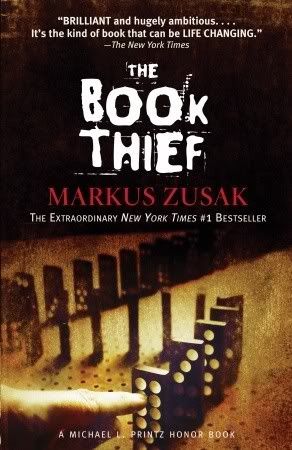
Review: The Book Thief by Markus Zusak

Title: The Book Thief
Author: Markus Zusak
Genre: Historical
Release Date: March 14, 2006
Publisher: Alfred A. Knopf Books
Pages: 550
Format: Paperback 
Literary awards: National Jewish Book Award, Book Sense Book of the Year Award for Children's Literature (2007), Prijs van de Kinder- en Jeugdjury Vlaanderen (2009), Printz Honor (2007), Exclusive Books Boeke Prize (2007), Exclusive Books Boeke Prize (2007), Zilveren Zoen (2008), Teen Read Award Nominee for Best All-Time-Fave (2010), Deutscher Jugendliteraturpreis (2009), ALA's Top Ten Best Books for Young Adults (2007), Abraham Lincoln Award Nominee (2010)
Read from Janaury 21 - February 7, 2012
My rating: 5 stars: I love it! It's amazing! + Favorite

Summary: It is 1939. Nazi Germany. The country is holding its breath. Death has never been busier, and will be busier still. By her brother's graveside, Liesel's life is changed when she picks up a single object, partially hidden in the snow. It is The Gravedigger's Handbook, left behind there by accident, and it is her first act of book thievery. So begins a love affair with books and words, as Liesel, with the help of her accordian-playing foster father, learns to read. Soon she is stealing books from Nazi book-burnings, the mayor's wife's library, wherever there are books to be found. But these are dangerous times. When Liesel's foster family hides a Jewish fist-fighter in their basement, Liesel's world is both opened up, and closed down.

One word: wow. This book is beyond amazing. It's one of those books that leave you speechless right after finishing, and will continue to stay with you even as time flies by. All I could say at that moment was I'm finished. Wow. *wipes tears* Wow. Just wow. *blows nose* For real. It touched my heart and left an imprint on my soul. A new favorite for me. 

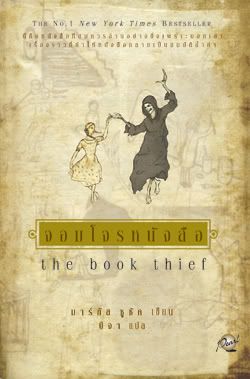
The Book Thief in Thai translation
I was reading this book two weeks before my midterm exams. So after two days of reading it, I had to put it on hold to study. I was able to continue reading after the exams were over. So you could say that I'd been reading this book for 6 days, not 17.

I've known The Book Thief since its publication in 2006. I feel stupid for not having been able read it sooner. I remember when I visited the national book fair 6 years ago, The Book Thief had just been published and was later translated into Thai and on sale for the first time there. I bought a copy. It came with its own nice paper bag that looked just like the cover, with gold print and all. I read the first chapter and then that was it. I wasn't much of a reader back then, nor was I any good at English. I'd promised myself that one day I would read the English original and understand it, and that happened just now, six years after the promise. I'm so glad I got to finish it and appreciate its beauty in its original text. I'm going to pick up the Thai translation one day and read to see if the translation lives up to the original at all.

“Like most misery, it started with apparent happiness.” The Book Thief tells a very complicated yet simple story. I don't quite know how to tell you this. This amazingly well-written book is narrated by Death himself during the World War II. And a beautiful narration it is, too. The book revolves around a young German girl named Liesel Meminger, whom Death calls The Book Thief. Liesel stole her first book, The Grave Digger's Handbook, when her brother was being buried in the snow, while they were traveling to Munich to live with their foster parents. She couldn't even read back then, but she stole it because she knew it would remind her of her brother and the train ride with their mother. Her foster parents are Hans and Rosa Huberman. Hans is a very fatherly person. He loves Liesel. He teaches her to read, plays her the accordion, and reads with her when she wakes up in the middle of the night screaming, after dreaming of the train and her brother again and again. Rosa, on the other hand, is a rude woman. She swears all the time. She also loves Liesel, but she doesn't show it. Liesel is getting used to the life on Himmel Street, and she makes some friends. Her best friend is Rudy Steiner, the boy next door, whose favorite thing to say to her is, "How about a kiss, Saumensch?", which gets rejected every time. Liesel is getting used to the life on Himmel Street until one day a Jew shows up before their house. Max Vandenburg, son of a friend of Hans' who once saved his life in the war, is kept hidden by the Hubermans in their basement. The Hubermans love him and care for him, still they can't shake the fear that the Nazi might find out there's a Jew in their basement. 


There's not a thing I don't like about the story, but right now let's talk about the narration. It's very unique and interesting (at least to me), because I have never read a book entirely narrated by intangibles before (Just in Case by Meg Rosoff is narrated partly by Fate and partly by third person point of view). Moreover, Death in this story isn't just death. Death has a cynical personality, and is haunted by humans. He's weary of his work, and he tries to understand humans. I've never looked at death that way before, but more like something sinister that loves taking away someone we love, so this really opened up my eyes. As someone who dreads and hates death, I think it's nice to see things through Death's eyes. It kind of made me think that maybe Death doesn't want to take anything away from us, but he has to. Just like the sun can't help but rise and shine every day. However, I might add that it didn't exactly make me feel any less negatively about death. It's just very interesting. So very interesting. I also loved that Death is impatient. He doesn't like mysteries: he will tell you the ending before you get there. The interesting thing is that it doesn't spoil the story at all. If anything, it enriches it, and keeps you on the edge of your seat. You know what, but not how, and you're dying to know the how. I guess it's not about the destination, it's all about the ride.

One of the rare things happened to me with The Book Thief: I loved the characters. Why is this a big deal? It is a big deal because I don't tend to have a lasting strong feeling about characters in standalone books (the only exception being Extremely Loud and Incredibly Close), and they don't stay with me. But not with this book. I loved the book lust in Liesel Meminger, just as much as I loved how she struggled to get over the death of her brother. I loved Rudy Steiner's ever-present starvation, his how-about-a-kiss-saumensch, his Jesse Owens event, his blond hair, his dusty bomb-hit lips. The only thing worse than a boy who hates you: a boy that loves you. Just thinking about him makes my eyes water. That boy is so wonderful. I also loved Hans Huberman, his accordion, his teaching Liesel to read, his staying up with her to get her through the night. He's a heavenly person. His calmness, kindness, his love. Rosa Huberman, however rude and tactless and wardrobe-like looking, is also lovable. She takes a Jew into her house without asking a single question or a having a single doubt. She reminds me of my mother, who doesn't talk very nicely, but whose love can be so great it can probably move a mountain. I loved the Jewish fist-fighter Max Vandenburg who always feels guilty about "having to put you all through this." I loved this guy because he dreams of fighting with Hitler, because he has written two books for Liesel, because he never asks for anything, because he makes me cry the most, because he is taken away, because he comes back, because.. because... just because.

You know, when you love a book this much, it's hard to find anything to say at all. You know what you say is not going to do the book justice. 

These characters, these people, this story. They'll stay in my heart for a long, long time. 

I don't know how he did it. Markus Zusak, I mean. 

Speaking of whom. His writing is extraodinary. Delightful. Magical. Reading his beautifully-strung-together words is pure joy. The words blew me away. I don't know how to explain it. They made me laugh, and they also moved me to tears. Heart-wrenching stuff. The power of words, indeed. Amazing what it can do to you, don't you think? 

I have a little advice for those of you reading this review who hasn't yet read this masterpiece of a book: DROP EVERYTHING NOW. READ THIS BOOK. 

Here goes my heart ♥.


------------------------

This review is also posted on Goodreads.
Related Posts Plugin for WordPress, Blogger...